How thoughtful product design helps Seattle businesses build products people choose to use.
Every day, thousands of people across Seattle download a new app, explore a digital service, or interact with software that promises to make life easier. Most people won't remember every feature they used. They'll remember how the experience made them feel. Did it help them accomplish their goal effortlessly, or did it create friction that made them search for an alternative?
That simple question has become one of the biggest differentiators in today's digital economy. Customers don't judge products solely by what they can do—they judge them by how naturally those products fit into their daily lives. A seamless experience builds trust. A confusing one sends users elsewhere.
Seattle's technology ecosystem has helped shape a generation of users with exceptionally high expectations. Home to some of the world's most innovative companies and thousands of ambitious startups, the city has become a benchmark for digital excellence. Building products in this environment requires more than technical expertise. It requires understanding people, solving meaningful problems, and designing experiences that continue delivering value long after launch.
Many digital products don't struggle because of poor engineering. They struggle because the team invested months building the right solution to the wrong problem.
For startups, the excitement of turning an idea into reality often creates pressure to move quickly. Product roadmaps fill with features, development begins, and launch dates become the primary focus. While speed is important, moving fast without understanding customers usually creates expensive redesigns, shifting priorities, and features that never truly solve a real problem.
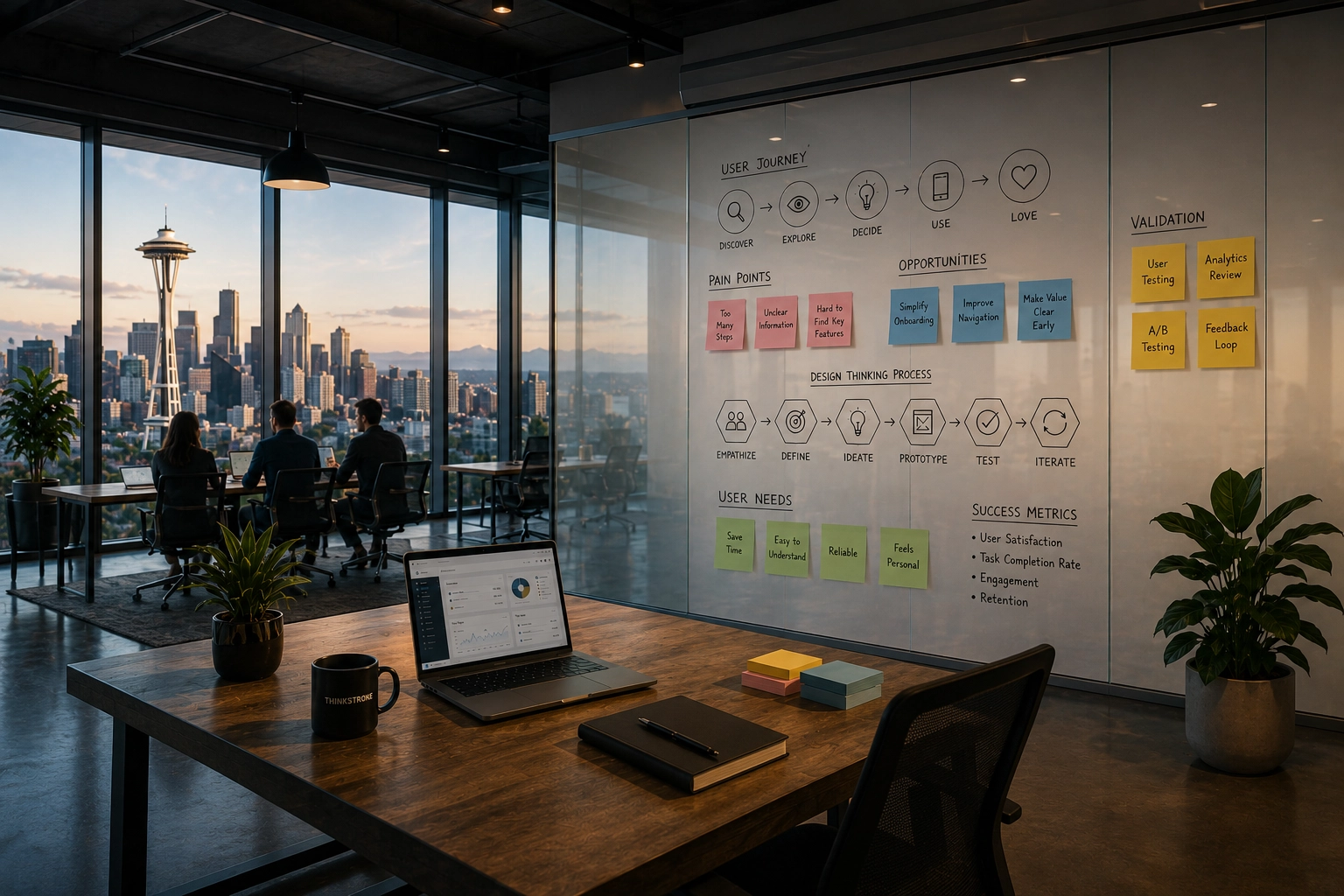
The strongest product teams take a different approach. Before opening Figma, writing code, or discussing technical architecture, they spend time understanding the people they're building for. They conduct interviews, observe workflows, validate assumptions, and identify the challenges customers experience every day. This discovery process provides the clarity needed to make confident product decisions.
The quality of a product is often determined long before the first screen is designed.
When research becomes part of product strategy, every design decision has purpose. Teams stop guessing what customers might want and begin solving problems that genuinely matter. Instead of reacting to assumptions, they make decisions backed by evidence and real customer insights.
Before moving into design, high-performing product teams typically:
Research doesn't slow innovation—it gives innovation direction.
Seattle has earned its reputation as one of the world's leading technology hubs. The city's culture of innovation has influenced not only how products are built but also what customers expect from every digital experience they encounter.
Today's users don't compare your product only with businesses in your industry. They compare it with every exceptional experience they've had—whether that's ordering groceries, collaborating with colleagues, booking appointments, or managing projects. Every intuitive interaction raises the standard for every product that follows.
For founders and product leaders, this changes the conversation. Success isn't measured by how many features make it into version one. It's measured by how quickly customers understand the product, how confidently they accomplish their goals, and how naturally the experience fits into their daily routine.
Innovation isn't measured by how much technology you build. It's measured by how naturally people use it.
Design has evolved beyond creating attractive interfaces. It now influences product adoption, customer retention, brand perception, and long-term business growth. In Seattle's competitive technology landscape, thoughtful product design has become a strategic advantage rather than a finishing touch.
As products grow, complexity often arrives one feature at a time. Every customer request feels valuable. Every competitive response seems necessary. Every new idea appears worth pursuing. Without careful prioritization, however, those additions slowly transform intuitive products into complicated ones.
The challenge isn't deciding what to build next. The real challenge is deciding what not to build.
Every new feature introduces another decision for users, another workflow to maintain, and another opportunity for confusion. Good product design isn't about offering fewer capabilities. It's about removing unnecessary effort while preserving meaningful value.
This is where strategy and design work together. Every design decision carries both a customer impact and a business impact. Products that people continue using aren't necessarily the ones with the longest feature list. They're the ones that make achieving a goal feel remarkably simple.
Good interfaces reduce clicks. Great products reduce decisions.
The best product teams continually ask themselves one question:
What can we simplify without reducing value?
That mindset shifts product conversations away from adding functionality and toward improving experiences. Instead of measuring progress by the number of features released, teams begin measuring success by how easily customers accomplish what they came to do.
Customers rarely remember products because they offered the most features. They remember products that respected their time.
Building a product without validation is one of the most common reasons startups waste valuable time and resources. An idea that feels promising in a meeting can behave very differently when placed in front of real users.
Creating simple wireframes or interactive prototypes allows entrepreneurs to test ideas before committing to development. Watching customers complete everyday tasks often reveals usability issues, confusing workflows, and opportunities for improvement that internal discussions fail to uncover.
Prototype testing should answer questions such as:
Finding these answers early reduces development costs while increasing confidence in the product roadmap.
Customers rarely remember individual screens. They remember how the entire experience made them feel.
Every interaction matters, from discovering your product for the first time to onboarding, completing key tasks, and returning for future use. Looking at the entire customer journey helps identify where users hesitate, lose confidence, or abandon important actions.
When each stage of the experience feels connected and purposeful, customers are more likely to trust the product and continue using it. Small improvements throughout the journey often create a much greater impact than large visual redesigns.
One of the biggest challenges for entrepreneurs is deciding what not to build.
Adding more features does not automatically create a better product. In many cases, simplicity creates a stronger customer experience because users can accomplish their goals without unnecessary distractions.
Every feature should solve a meaningful problem. If it does not contribute directly to the product's primary purpose, it can often wait for a future release. Products that are easy to understand and easy to navigate are more likely to gain customer trust and encourage long-term adoption.
A Minimum Viable Product (MVP) is often misunderstood as a product with fewer features. In reality, an effective MVP focuses on solving one meaningful customer problem exceptionally well. Rather than trying to satisfy every possible user need, it delivers enough value to validate an idea and gather meaningful feedback.
Launching with a focused MVP allows entrepreneurs to learn faster, reduce development costs, and make informed decisions about future enhancements. Customer feedback gathered during the early stages of a product often provides more valuable direction than months of internal planning. Products rarely launch fully formed; they improve through continuous iteration.
Launching a product is an exciting milestone, but it should never be viewed as the finish line. A successful launch doesn't provide all the answers—it creates the opportunity to begin learning from real customers.
Before launch, product decisions are guided by research, interviews, and prototypes. After launch, those assumptions are replaced by something even more valuable: real user behavior. Analytics reveal where users hesitate, customer interviews uncover unmet needs, usability testing highlights friction, and support requests expose problems that weren't visible during development.
The strongest product teams treat every release as an experiment. They observe, measure, refine, and improve continuously. Instead of asking, "What feature should we build next?" they ask, "What have our customers taught us since the last release?"
Products don't become successful because they launch. They become successful because they continue learning.
Continuous improvement creates products that remain relevant as customer expectations evolve. Rather than reacting to every trend, successful businesses focus on solving real problems better with every iteration.
A practical product improvement cycle often looks like this:
This iterative approach helps businesses reduce risk, prioritize meaningful improvements, and create products that become more valuable over time.
Exceptional products are rarely the result of one brilliant designer or one talented engineer. They are created when people from different disciplines work toward a shared understanding of the customer.
Founders bring the business vision. Product managers define priorities. Designers focus on usability and experience. Engineers transform ideas into reliable products. Marketing teams understand customer acquisition, while customer support provides firsthand insight into everyday user challenges.
When these teams work independently, products often feel disconnected. Features may solve technical problems but overlook customer needs. Marketing promises experiences the product doesn't yet deliver. Design decisions become isolated from business objectives.
The best organizations remove those barriers. They encourage collaboration from the earliest stages of product discovery, ensuring every decision considers customer needs, technical feasibility, and business goals.
Great products aren't built by departments. They're built by teams aligned around a shared purpose.
Collaboration also accelerates decision-making. Instead of correcting problems after launch, cross-functional teams identify opportunities earlier, reducing costly redesigns and creating more cohesive customer experiences.
Customers rarely describe trust as a feature, yet it influences every interaction they have with a product.
Trust is built through hundreds of thoughtful design decisions. Clear navigation, consistent interactions, accessible interfaces, reliable performance, transparent communication, and predictable behavior all contribute to the confidence users place in a product.
When people trust a product, they spend less time questioning how it works and more time achieving their goals. They feel comfortable returning, recommending it to others, and integrating it into their daily routines.
On the other hand, small moments of uncertainty quickly erode confidence. Confusing navigation, inconsistent interfaces, unexpected errors, or unclear messaging create hesitation that often leads users to abandon the experience entirely.
Every feature solves a problem. Every feature also creates another decision for the user. Great product design reduces those decisions instead of increasing them.
Trust isn't created through marketing campaigns alone. It's earned through consistent experiences that demonstrate reliability every time someone interacts with your product.
Beautiful interfaces may capture attention, but strategy determines whether a product creates lasting value.
Without a clear strategy, design becomes reactive. Teams focus on visual improvements, feature requests, or competitor comparisons without understanding how those decisions support broader business objectives.
Product strategy provides that direction. It connects customer needs with business goals, ensuring every design decision contributes to measurable outcomes rather than temporary improvements.
Research identifies customer problems. Strategy prioritizes which problems matter most. Design transforms those priorities into intuitive experiences. Development brings those experiences to life. Together, these disciplines create products that are not only visually appealing but also commercially successful.
Design creates experiences. Strategy creates direction. Together, they create products people choose to use.
Organizations that integrate research, strategy, and design consistently make better decisions because every improvement is evaluated through both customer value and business impact.
Technology will continue to evolve. New platforms will emerge. Customer expectations will rise. Artificial intelligence will reshape workflows, and digital experiences will become increasingly sophisticated.
Yet one principle remains constant: products succeed when they solve meaningful problems for real people.
The companies that continue to grow are those that remain curious about their customers, embrace continuous learning, and refine their products with intention rather than assumption. They understand that innovation isn't about adding more technology—it's about creating experiences that feel natural, valuable, and effortless.
For businesses building products in Seattle's dynamic technology landscape, thoughtful product design is no longer optional. It's a competitive advantage that influences customer satisfaction, brand loyalty, and long-term growth.
At Thinkstroke, we believe every successful product begins with understanding people. When research informs strategy, strategy guides design, and design focuses on human experiences, businesses create products that people don't just use—they trust, recommend, and return to.
Seattle's thriving technology ecosystem, startup community, and culture of innovation have created customers with exceptionally high expectations. Businesses that build products here benefit from a strong talent pool while also being challenged to deliver world-class user experiences.
Research reduces assumptions, uncovers genuine customer needs, and helps teams prioritize solutions that create meaningful business and user value before significant development investment begins.
Focus on solving one meaningful problem exceptionally well. Validate ideas early, prioritize customer outcomes over feature quantity, and continuously remove unnecessary complexity as the product evolves.
Thinkstroke combines product strategy, UX research, human-centered design, and business thinking to help organizations create digital products that align customer needs with measurable business outcomes.
The best digital products aren't remembered because they offer the most features. They're remembered because they make complex problems feel simple.
Seattle's technology community has demonstrated that exceptional product design isn't about following trends or adopting the latest technology. It's about deeply understanding people, making thoughtful decisions, and continually improving the experiences that matter most.
Businesses that invest in research, embrace collaboration, simplify intentionally, and learn from every customer interaction build products that stand the test of time. They don't simply launch software—they create experiences that customers trust, recommend, and choose again and again.
At Thinkstroke, we believe every great product has a story. That story begins by understanding people, continues through purposeful design, and succeeds when it creates lasting value for both businesses and the customers they serve.


22525 SE 64th Pl Suite 2345
Issaquah Washington